We’re over halfway through 2025, and there’s been no shortage of action across the TMBC network. From new sightings and seasonal biosecurity reminders to community activations and partner milestones, the momentum is building – and we’re here to keep you in the loop.
The Impact of wallabies
Over the past four years, the Tipu Mātoro National Wallaby Eradication Programme has collectively focused on mobilising and educating the public about the pest wallaby problem. A rise in public reports of wallaby sightings reflects the progress being made, with greater awareness and growing support for the programme’s elimination efforts.
Despite this momentum, more work remains to be done to ensure New Zealanders fully understand the significant economic and environmental costs of not protecting farms, forests, bush, and native species from wallaby spread. That combined focus continues to drive the work of the programme.
Bay of Plenty Regional Council and Environment Canterbury have produced a new video showcasing the benefits of this collaborative approach and the positive impacts so far. Featuring interviews with farmers, iwi, conservationists, researchers, and contractors, it highlights the people and progress behind the programme’s success.
Mowing the Lake to Tackle Invasive Lake Weed
Hornwort is a fast-growing aquatic weed that can grow up to 10m deep, and unfortunately, it’s already present in several Rotorua Te Arawa lakes.
Due to its invasive nature, it inhibits the growth of native flora and fauna and degrades water quality by absorbing nutrients such as phosphorus and nitrogen (which can cause toxic algal blooms).
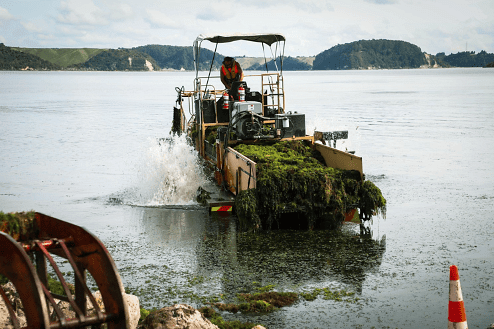
An innovative solution by the Bay of Plenty Regional Council is the use of a specialised weed harvester to ‘mow’ the hornwort. While there is no silver bullet for eradicating the weed from the lake, the mower does a good job of managing the nutrient load.
Recently, over 330 tonnes of hornwort was removed from Lake Rotoehu and the harvested hornwort was then transported to Ecogas in Reporoa, to be turned into biogas energy and bio-organic fertiliser.
‘Weedy Wednesday’ – Helping People Help Themselves
Have you got pest plants that need controlling? Bay of Plenty Regional Council’s ‘Weedy Wednesday’ bite-sized videos have the solution.
For the past few years, Council has shared a range of videos to its 45,000 followers on Facebook with weedy tips on topics as varied as controlling privet to selecting the right herbicide. Many of the pests featured are Advisory pest plants in the Bay of Plenty Regional Council Pest Management Plan, which means that landowners are responsible for controlling them and stopping their spread, but Council provide control advice.Check out one of the recent videos by Biosecurity Officer Dave Grimmer on dealing with Elephant’s Ear and Arum lily.
Yellow-Legged Hornet Detections in Auckland
Biosecurity New Zealand is following up after two recent detections of male yellow-legged hornets (Vespa velutina) in the Auckland region — one in Grafton and one in Albany.
This hornet species is not known to be present in New Zealand, and these are the first detections of their kind in the country. While not a notifiable or unwanted organism, the yellow-legged hornet is considered a significant threat the honeybees and wild pollinators overseas due to its predatory behaviour.
Both hornets were found sitting on the outside of buildings. No nests have been located, and there is currently no clear link between the detection sites or any recently imported goods. As this species mates in autumn and queens overwinter, any further signs are unlikely until Spring.
A factsheet is below with information on identifying the species and how to report sightings. Anyone who comes across a suspicious wasp, hornet, or large paper-like nest is encouraged to report it to Biosecurity New Zealand via:
📞 0800 80 99 66 or 🖥 report.mpi.govt.nz